

The UK social housing sector is at risk. With fewer than 30% of housing associations having full board-level cyber governance in place…
As we begin 2026, housing associations across the UK remain prime targets for cyber criminals - not because they sit at the centre of the digital economy, but because they hold vast volumes of sensitive resident data, operate essential services, and often lack the maturity and investment that larger enterprises take for granted.
The past few years have shown that cyber threats against the housing sector are far from hypothetical or minor. A significant proportion of UK housing associations have already experienced cyber-attacks or breaches in recent years, highlighting persistent vulnerability and the urgent need for sector-wide transformation in cyber resilience.
This article examines exactly how the current threat landscape looks within the sector, why social housing associations are so heavily targeted, and what strategic steps HA’s can take in 2026 and beyond to protect themselves, their tenants, and their critical operations.
Why Housing Associations Are High-Value Targets
Housing associations manage a rich and varied set of systems and data that make them attractive to attackers:
Extensive Personal Data Holdings
Associations and housing providers hold large quantities of tenant and applicant personally identifiable information (PII) - including names, dates of birth, contact details, government IDs, financial hardship status, support needs, and payment histories. This data is highly sought after on criminal markets where identity theft, fraud, and data extortion are lucrative.
Critical Operational Systems
Core service platforms - such as housing management systems, case and repair portals, and payment processing environments - are critical to everyday operations. Disruption to these systems not only affects internal workflows, but also directly impacts residents attempting to report maintenance issues, make rent payments, or access vital support services. This creates leverage for attackers seeking to maximise disruption and negotiate ransom.
Legacy Technology and Fragmented Systems
Many housing associations operate with outdated and fragmented technology stacks that were not architected for modern threats. Legacy systems often contain unpatched vulnerabilities and are poorly segmented, providing attackers with easy entry points into wider corporate networks.
Third-Party Dependencies
Housing associations frequently rely on third-party vendors for IT support, maintenance, CRM platforms, payment gateways, and outsourced services. Each external connection introduces an additional vector for compromise - and attackers have increasingly targeted these trusted suppliers to achieve wider reach.
Pressure to Maintain Essential Services
Unlike a typical commercial entity, housing associations cannot simply “go offline” during an outage; they are responsible for the welfare and safety of vulnerable residents. This pressure, combined with limited downtime tolerance, creates a strong operational incentive for organisations to pay or quickly remediate after a successful breach, which in turn attracts more criminal attention.
How The Threat Landscape Evolved for Housing Associations in 2025-26

Cyber criminals have adapted their approaches to exploit the housing sector’s specific risk profile:
Ransomware and Data Extortion
Ransomware remains one of the most significant threats. Even if systems are not encrypted, attackers increasingly steal data (including sensitive PII) and threaten to publish or misuse it unless payment demands are met, creating dual leverage. Globally and in the UK, such data extortion tactics are now more common than traditional encryption attacks.
Supply Chain and Third-Party Exploits
Attackers are shifting focus toward third-party software and service providers. By compromising a single vendor with access to multiple housing associations, malicious actors can gain access to multiple environments simultaneously - multiplying impact and complicating containment.
Phishing, Malware, and Credential Theft
Phishing campaigns aimed at social housing staff and contractors feed credential theft, which in turn enables further lateral movement and deeper breaches. With sprawling digital systems and mixed cloud/on-premises infrastructure, these attacks find fertile ground.
Operational Disruption Attacks
Beyond data theft, attackers recognise the impact of service disruption - downtime in repair portals, tenant communications, or rent processing can cascade into reputational harm, regulatory scrutiny, and loss of trust.
Real World Examples: Lessons From Sector Incidents
Examples from recent years illustrate the severity of the threat:
Clarion Housing Association: In June 2022, the UK’s largest housing association suffered a major cyber incident that disrupted IT systems, phone lines, and online services essential for tenants. The fallout was serious: Clarion eventually reported a £17 million reduction in operating surplus and significant reputational harm due to service interruption.
Connexus Housing: In December 2023, Connexus was hit by a cyber attack involving unauthorised access to internal systems. While they took systems offline swiftly and notified the Information Commissioner’s Office (ICO), there was uncertainty around whether customer data was compromised. Residents were advised to be cautious of phishing and scam communications as a result.
Related Local Government Attacks: Housing risk is not confined to associations alone. For example, London councils like Hackney have faced ransomware and data exposure incidents in recent years, affecting tens of thousands of residents and underscoring how tenant data across public bodies is a broad criminal target.
Recent UK Council Data Risks: Even in late 2025, councils such as Kensington and Chelsea suffered data exposure incidents that placed tens of thousands of households at risk of follow-up scams and phishing, underscoring that public housing data continues to be attractive to criminals.
State of Preparedness: A Sector Still Behind
Despite rising risks, many UK housing associations are still underprepared for high-impact attacks:
Around one quarter of UK housing associations have experienced an attack or breach since 2020, highlighting how pervasive the threat has become.
Three-quarters do not feel confident in their current incident response planning, an alarming indication that most providers are not ready to contain or recover from a serious breach.
Only 4% of housing associations believe the sector as a whole is fully prepared for a ransomware attack, underlining a widespread lack of resilience.
These statistics suggest that, without significant investment and strategic transformation, housing associations will continue to face outsized risk relative to their defensive maturity.
Why the Sector Is Targeted: Structural and Operational Factors
Housing associations are attractive to attackers for several structural reasons:
High-Value Resident Data
From payment information to detailed tenant records, the sheer volume and sensitivity of data held make housing organisations a rich target for identity theft and financial fraud.
Tight Operational Priorities
Associations must maintain service availability and tenant support. Downtime can jeopardise repairs, rent collection, and emergency services, creating pressure to prioritise restoration - and sometimes pay ransoms - over forensic containment.
Under-Resourced Security Programmes
Budget and workforce limitations mean many associations lack mature security functions, dedicated incident response teams, or continuous monitoring capabilities.
Legacy and Fragmented IT Architectures
Older systems not designed for modern security controls remain deeply embedded across many housing providers, creating attack vectors that are low-effort, high-reward for criminals.
Complex Supplier Ecosystems
Reliance on external vendors - from CRM platforms to maintenance portals - increases complexity and potential attack surfaces, creating gaps that sophisticated campaigns can exploit.
Strategic Steps Housing Associations Must Take in 2026
To reduce risk and improve resilience, UK housing associations should prioritise the following actions:
1. Embed Cyber Security in Governance
Cyber risk must be elevated to board and executive agendas. This includes documented responsibilities, risk reporting, and clear accountability for data protection and cyber readiness - not just in IT departments.
2. Strengthen Incident Response and Recovery
With a large majority lacking confidence in their response planning, formalised and tested incident response plans are critical. These should include communications strategies for tenants, coordination with regulators, and simulated breach scenarios.
3. Protect Identity and Access
Phishing-resistant multi-factor authentication (MFA) and strong identity governance are essential. Housing associations must reduce reliance on legacy authentication methods and monitor for anomalous access patterns.
4. Secure Operational and Third-Party Systems
A focused programme that prioritises patching, segmentation, and secure configuration, particularly for housing management systems, payment portals, and building systems, reduces exploitable surfaces. Third-party risk assessments and contractually enforced security standards are necessary.
5. Continuously Monitor and Detect Threats
24/7 monitoring with real-time alerting helps detect intrusion attempts early. Organisations should invest in detection tools and admin visibility across cloud, network, and endpoint environments.
6. Educate and Empower Staff
Human error remains one of the most common infection vectors. Regular phishing simulation, awareness training, and role-based security education help reduce risk exposure.
7. Adopt Resilience-Oriented Frameworks
Frameworks such as ISO 27001, Cyber Essentials Plus, and the NCSC Cyber Assessment Framework provide structured roadmaps for measurable security improvement.
Join Our Upcoming Webinar: The Evolution of Cyber Security in Housing for 2026
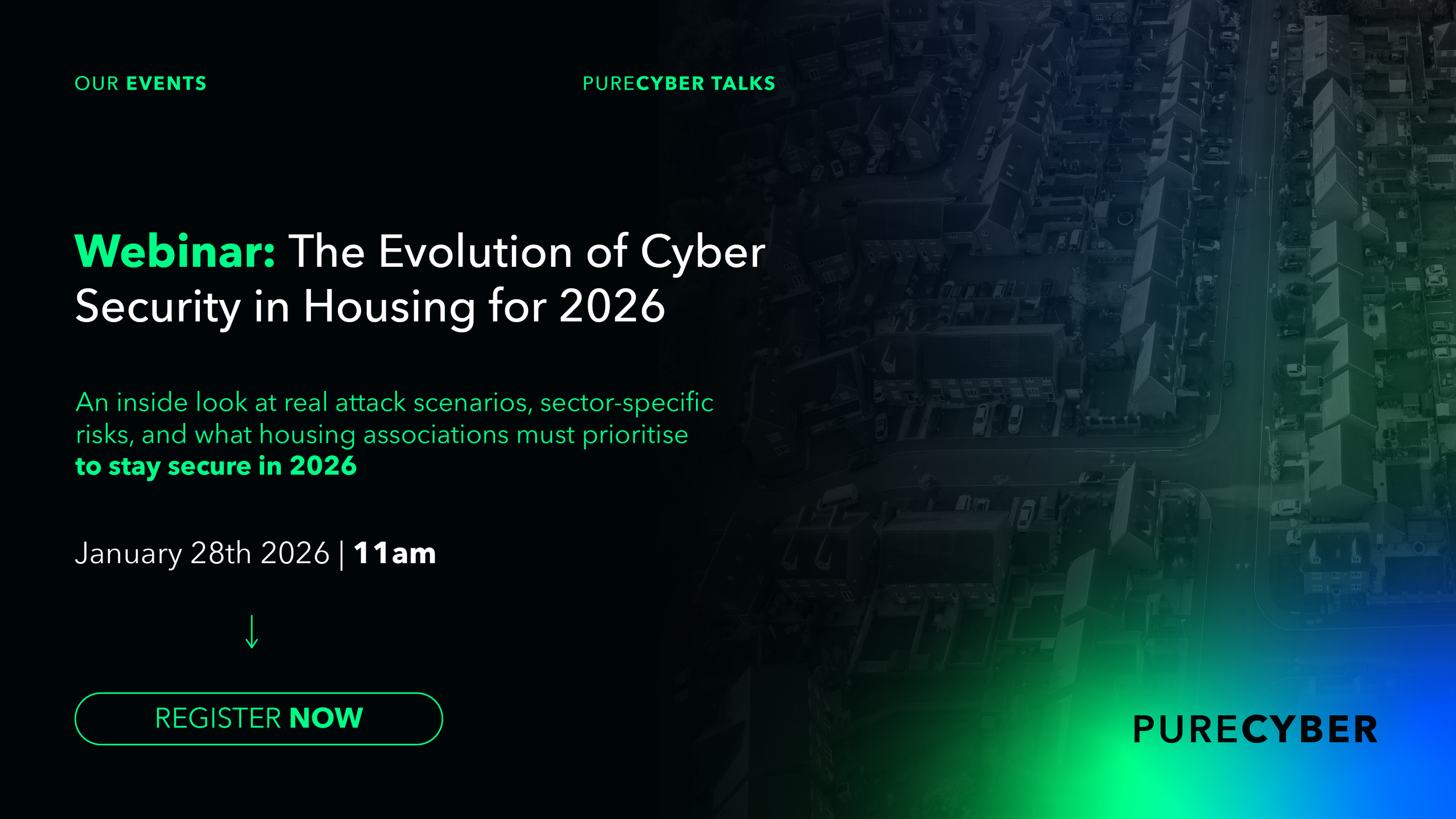
Join this practical, live session on January 28th, where we walk you through a real attack timeline, discuss barriers to resilience, and give you clear steps to strengthen your defence from an insider perspective.
You’ll get exclusive housing sector insights from Nigel Lee, Head of ICT at Cardiff Community Housing Association (CCHA) alongside PureCyber CEO, Damon Rands.
You’ll also receive a free Housing Sector Cyber Resources pack when you register for this webinar.
Protecting Your Tenants, Services, and Data in 2026 - With the Right Partner
Effective cyber security in the housing sector heavily depends on solutions that reflect how housing associations actually operate - from legacy systems and third-party housing platforms to lean internal teams and high regulatory expectations. PureCyber has extensive experience supporting UK housing associations and social housing providers with security services designed specifically around these realities.
We work with housing organisations across the full cyber security lifecycle. Our 24/7 Managed Detection and Response (MXDR) service provides continuous monitoring of tenant management systems, cloud platforms, and endpoints, enabling rapid detection of credential misuse, ransomware activity, and unauthorised access before incidents escalate. Paired with expert threat intelligence tailored to the housing sector, allowing organisations to understand which attack techniques are actively being used against similar providers and where their exposure is greatest.
PureCyber also delivers practical penetration testing for HA’s, focusing on the systems that matter most - identity infrastructure, remote access, housing management platforms, and supplier integrations. These assessments go beyond compliance-driven testing, helping organisations identify how an attacker could realistically move through their environment and what controls will materially reduce risk.
Governance and readiness remain critical priorities. We support housing association boards and executive teams with incident response planning, and regulatory alignment consultancy, ensuring organisations can respond decisively to incidents while meeting ICO and sector expectations.
Our cyber awareness and executive-level training further strengthens resilience by addressing one of the most common root causes of incidents: human error and social engineering.
PureCyber’s approach is built on long-term partnership, not point-in-time fixes. We have a strong track record of helping housing associations improve cyber maturity over a sustained partnership - strengthening defences, increasing risk visibility, and embedding security into day-to-day operations without disrupting essential services.
How PureCyber Can Help
The PureCyber team are here to take over the burden of your cyber security and ensure your organisation’s data remains secure and well managed, with proactive monitoring and real-time threat intelligence. For housing associations seeking a cyber security partner with proven sector experience, practical delivery capability, and a clear understanding of housing-specific risk, PureCyber provides the expertise and support needed to protect tenant data, maintain service continuity, and demonstrate robust cyber governance in 2026 and beyond.
Providing you with a comprehensive and reliable cyber department to support you in all aspects of your security efforts, including: 24/7 Security Operations Centre (SOC) services, MXDR (Managed Extended Detection & Response),Threat Exposure Management (TEM) & Brand Protection Services & Penetration Testing.
PureCyber is recognised as an Assured Service Provider by the NCSC to offer governance and compliance consultancy services/audits. Contact our team of compliance experts to enquire about our full range of Governance Support - including Cyber Essentials, ISO 27001, FISMA, SOC1 and SOC2 standards.
Get in touch or book a demo for more information on our services and how we can safeguard your organisation with our expert cyber security solutions.
Email: info@purecyber.com Call: 0800 368 9397